AI Agent vs Automation: What Is the Difference for Small Business?
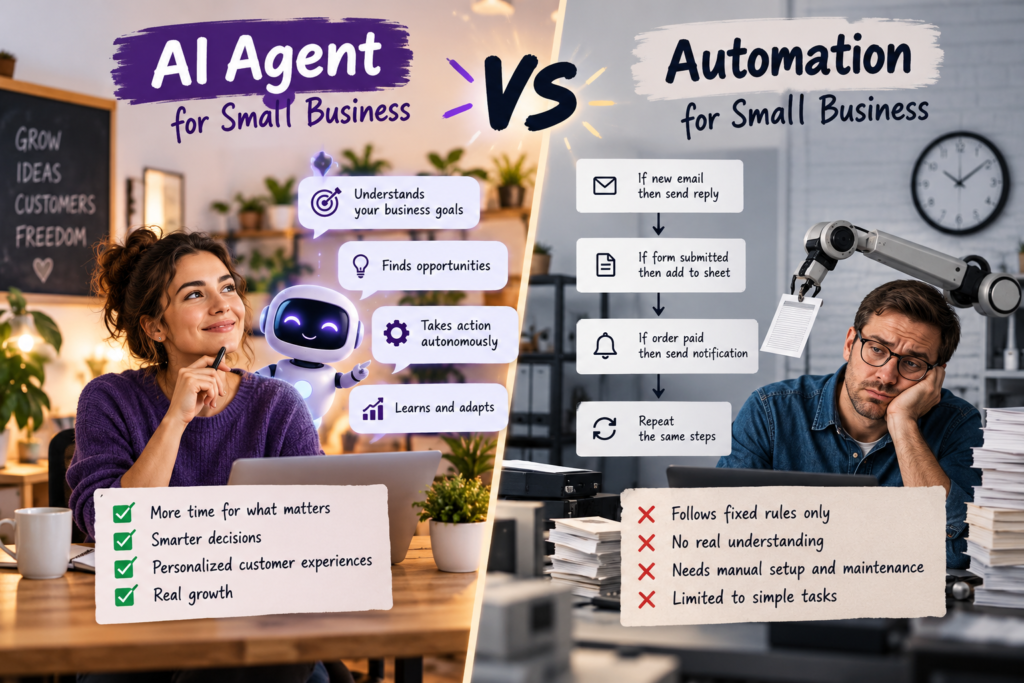
AI agents and workflow automations are often grouped together, but they solve different problems. Traditional automation is strongest when the path is known in advance. An AI agent becomes useful when the system must interpret information, choose what to do next and adapt as conditions change.
n
For a small business, the distinction matters because an agent is not automatically an upgrade over automation. A predictable process is often cheaper, easier to audit and safer when it stays deterministic. The best solution is frequently a hybrid: automation controls the process while AI handles the parts that genuinely require interpretation.
n
What is workflow automation?
n
Workflow automation connects predefined triggers, rules and actions. A form arrives, data is copied to a CRM, an email is sent and a task is created. The exact software may vary, but the path is mostly known before the workflow starts.
n
This makes conventional automation ideal for repetitive work. When the same input should produce the same action every time, adding an autonomous decision-maker may create complexity without adding useful value.
n
What is an AI agent?
n
An AI agent is designed to work toward a goal when every step cannot be fully scripted in advance. It can interpret unstructured information, reason about what it finds, choose among available tools and adapt its next step.
n
For example, an inbox agent could read a message, determine what the sender needs, search connected information and prepare the appropriate next action. A traditional workflow can also process email, but it normally depends on explicit rules such as the sender, subject line or predefined category.
n
AI agent vs automation: the practical difference
n
- n
- Automation: follows predictable steps and rules; usually easier to test and audit.
- AI agent: can choose or adapt steps based on context; useful for less predictable inputs.
- Hybrid workflow: keeps fixed processes deterministic while using AI for selected decisions or content.
n
n
n
n
The difference is therefore not simply “old technology versus new AI.” It is predictability versus adaptability. If a business already knows exactly what should happen, automation is often the cleaner solution.
n
Example: customer support
n
Imagine a customer submits a support request. A traditional automation can create a ticket, attach the customer record, notify the right team and send an acknowledgement. Those steps do not require an AI agent.
n
AI becomes useful when the message itself needs interpretation. A model could classify the request, summarize a long complaint, identify likely urgency or draft a proposed response. The workflow can then return to deterministic rules for routing and record keeping.
n
This hybrid design limits the number of decisions delegated to AI while still capturing much of its productivity benefit.
n
Example: appointment management
n
A standard automation can send a reminder 24 hours before an appointment because the trigger and action are fixed. An agent may be more useful when a customer writes, “I can’t make tomorrow afternoon; find another time next week after work.” Understanding the request and evaluating options requires more interpretation.
n
Even then, businesses may want the agent to propose available slots while the scheduling system performs the final validated booking.
n
When should a small business use automation?
n
Start with regular automation when the process has stable rules and errors would be costly or annoying. Good examples include:
n
- n
- appointment reminders;
- form routing;
- invoice notifications;
- scheduled reports;
- simple data transfers;
- standard status updates;
- creating tasks after a known trigger.
n
n
n
n
n
n
n
n
These tasks benefit from consistency more than judgment.
n
When does an AI agent make sense?
n
An agent becomes more attractive when the work involves unstructured information or when the next step depends on what the system discovers. Examples include inbox triage, research preparation, comparing several options, synthesizing documents and coordinating a multi-step task across tools.
n
The important question is whether adaptability creates enough value to justify additional monitoring, cost and risk.
n
Why hybrid workflows are often better
n
A useful pattern is to keep the outer process deterministic and let AI handle a small number of uncertain steps inside it. This gives a business clearer checkpoints and makes failures easier to diagnose.
n
For example, automation can always capture a lead and store it in the CRM. AI can summarize the inquiry and suggest a category. A fixed rule can then route the lead to the appropriate person. The AI helps with ambiguity without controlling the entire workflow.
n
What about security and human approval?
n
The more tools an agent can use, the more important permissions become. Reading information is different from sending an email, deleting a file, publishing content or spending money.
n
Use the minimum permissions needed for the task and keep human approval for consequential actions. Businesses should also test what happens when the agent receives incomplete, misleading or unexpected information rather than evaluating only ideal examples.
n
How to choose between an agent and automation
n
- n
- Write down the exact task. Avoid starting with the technology.
- Separate fixed steps from judgment calls. Fixed steps are strong automation candidates.
- Automate predictable work first. This creates a stable baseline.
- Add AI where ambiguity is real. Do not use an agent simply because it is newer.
- Limit permissions. Give the system only the tools and data required.
- Keep approval gates. Require human confirmation for high-impact actions.
- Measure the result. Track time saved, errors, corrections and total cost before expanding.
n
n
n
n
n
n
n
n
A simple decision rule
n
If you can describe the entire process as “when X happens, always do Y,” start with automation. If the process sounds more like “look at what happened, decide what it means, then choose the appropriate next step,” AI may add useful flexibility.
n
If both descriptions apply to different parts of the same process, build a hybrid workflow.
n
Bottom line
n
AI agents do not make traditional automation obsolete. They extend automation into situations where information is messy and the correct next step cannot always be predetermined.
n
Small businesses should therefore automate predictable work first and introduce agents selectively. This approach is usually easier to control, measure and improve than handing an entire process to an autonomous system from day one.
n
For an example of the longer-horizon model capabilities that can support increasingly complex AI workflows, see Gemini 4 Argon explained. You can also use our AI tools for small business workflow guide to evaluate where AI belongs in a real process.