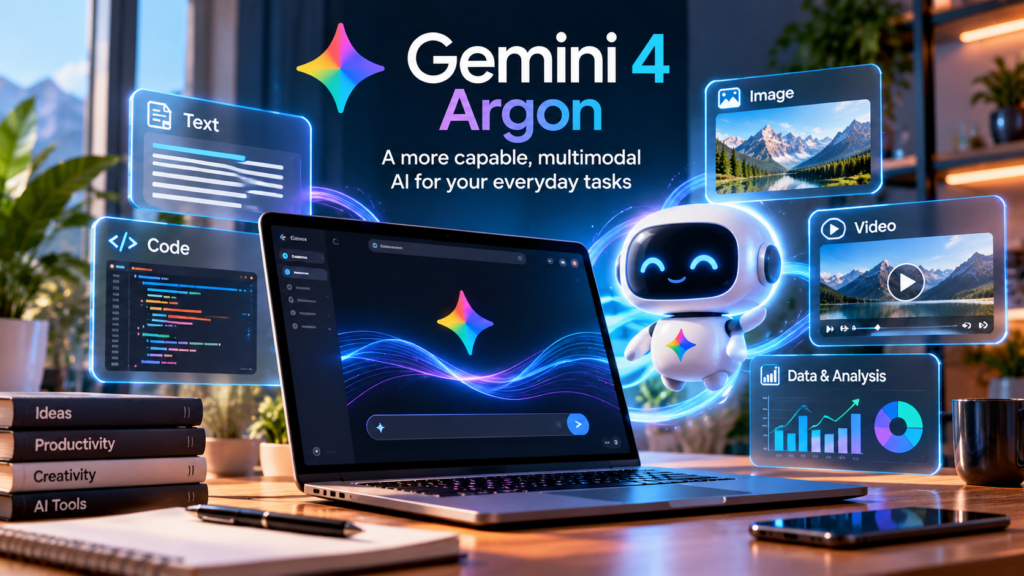
Google has introduced Gemini 4 Argon, a frontier AI model designed for long, multi-step work across coding, enterprise research and professional workflows. The important point for businesses is not simply that Argon is more powerful. It is that Google is pushing Gemini toward longer, more complex jobs that require sustained reasoning, large amounts of context and repeated tool use.
n
Update — October 14, 2026: Gemini 4 Argon is now broadly available, following Google’s October 13 rollout. Google AI Pro and Ultra subscribers can access it in the Gemini app and AI Mode in Search. Developers can use the paid Gemini API (model ID gemini-4-argon); Google AI Ultra subscribers can also use it in AI Studio and Antigravity. Enterprise access is available through Google’s business offerings. Availability depends on product and subscription, and organizations should test real workflows before relying on it for high-stakes decisions.
n
What is Gemini 4 Argon?
n
Gemini 4 Argon is one of Google’s frontier models for demanding work such as software engineering, enterprise knowledge tasks, finance, legal analysis and cybersecurity. These are jobs where the model may need to keep track of many documents, instructions or intermediate steps instead of answering a single prompt.
n
That makes Argon different from the everyday use of an AI chatbot for rewriting an email or summarizing a short document. Its value is more likely to appear when a project becomes too large or too interconnected for a short conversational workflow.
n
Why the one-million-token context window matters
n
Google says Argon supports a context window of up to one million tokens. In practical terms, a large context window can allow a model to work with much more material in one session: code repositories, research documents, policies, contracts, reports or other large collections of text and data.
n
The headline number should not be confused with guaranteed accuracy. Giving a model more context does not automatically mean every detail will be understood correctly. Businesses still need evaluation, source checking and clear instructions, especially when decisions have financial, legal or security consequences.
n
Long-horizon reasoning is the bigger story
n
Argon is designed for workflows that unfold over many steps. That matters because many valuable business tasks are not single-prompt problems. Researching a market, investigating a software bug, reviewing a large set of documents or preparing an implementation plan may require the model to gather information, revise assumptions and keep working toward the same goal.
n
This is part of a broader shift from AI that mainly produces answers toward AI that can support longer projects. It also brings Argon closer to the world of agentic workflows, where models use tools and complete sequences of actions rather than responding once.
n
Where could businesses use Gemini 4 Argon?
n
Software engineering
n
A large-context model can be useful when developers need an AI system to reason across many files, understand dependencies and follow a change through a substantial codebase. The real test is not whether it can generate code, but whether it can preserve constraints and avoid introducing new problems across a long task.
n
Research and knowledge work
n
Teams may use models like Argon to compare large document collections, identify themes, prepare structured summaries or help investigate questions that require information from several sources. Human review remains important when the output supports consequential decisions.
n
Cybersecurity and technical analysis
n
Long-context reasoning can also help analyze logs, code, documentation and security findings together. Access should be tightly controlled because the same workflows may involve sensitive company information or powerful tools.
n
What does Gemini 4 Argon cost?
n
Google announced introductory API pricing of $2 per million input tokens and $10 per million output tokens. Those numbers need context: long-running workflows can consume far more tokens than a simple chatbot exchange, so the cost of a useful result matters more than the advertised price per token.
n
Before deploying a large workflow, measure how much context is actually necessary, how often the model needs to run and how much human review remains. A smaller or faster model may still be the better business choice for routine tasks.
n
Why the rollout is gradual
n
Google is releasing Argon in stages rather than treating it as an instant replacement for existing Gemini models. A staged rollout gives Google time to collect feedback and evaluate the model on demanding real-world workloads before access becomes broader.
n
For businesses, this is a reason not to design a critical process around availability that has not yet reached the tools or accounts they use. Test first, keep alternatives available and verify current access before committing resources.
n
Gemini 4 Argon vs everyday AI tools
n
Most small businesses do not need the most capable model for every task. Drafting routine copy, classifying simple messages or summarizing short documents may be faster and cheaper with a lighter model or conventional automation.
n
Argon becomes more interesting when complexity is the bottleneck: large inputs, difficult reasoning, many connected steps or work that benefits from keeping substantial context available. Choosing the right model therefore starts with the job, not the benchmark ranking.
n
What businesses should evaluate before adopting it
n
- n
- Availability: confirm that Argon is actually available in the product or API your workflow requires.
- Data access: decide what company information the model is allowed to process.
- Human approval: keep people in control of high-impact decisions and actions.
- Cost: measure complete workflow cost rather than only token pricing.
- Accuracy: test with representative real tasks and record failure cases.
- Model fit: compare Argon with a smaller model before assuming more capability produces better economics.
n
n
n
n
n
n
n
Bottom line
n
Gemini 4 Argon matters because it shows where frontier AI is heading: larger working context, longer reasoning chains and models designed to stay with complicated tasks for more of the workflow.
n
For businesses, the sensible strategy is not to use Argon everywhere. Identify tasks where complexity, context or multi-step reasoning genuinely limits current tools, test those tasks carefully and keep human control around consequential actions.
n
For a practical explanation of when this type of adaptive system is useful, see our guide to AI agents vs automation for small business.