For years, using artificial intelligence meant opening an app or visiting a website.
That may be about to change.
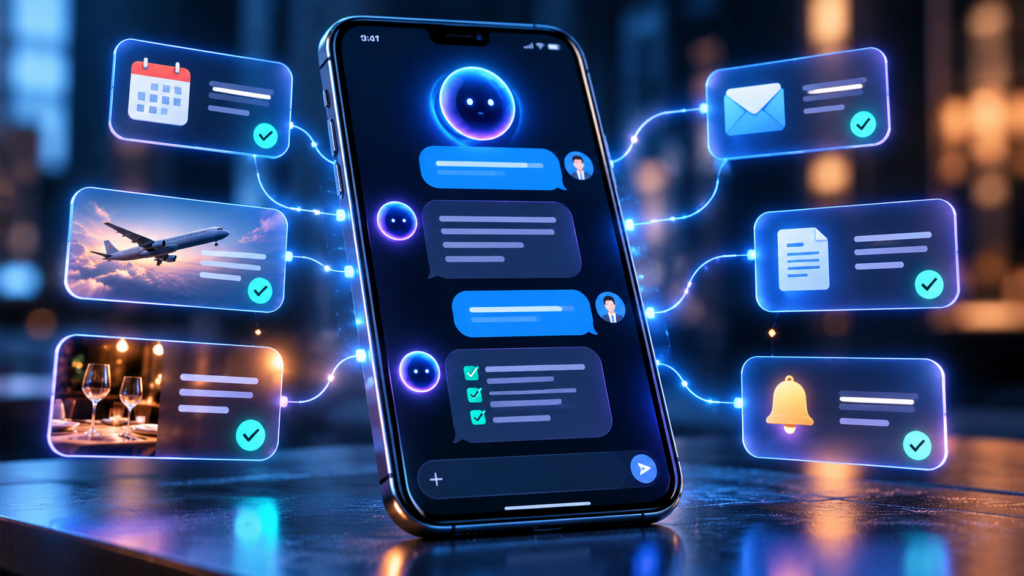
A new generation of AI assistants is moving into one of the most familiar interfaces on your phone: text messages.
Instead of opening a chatbot and typing a prompt, you could simply send a message to an AI assistant the same way you text a friend.
“Find me a restaurant for tonight.”
“Remind me when this flight gets cheaper.”
“Move tomorrow’s meeting to the afternoon.”
“Cancel the subscription I forgot about.”
And the agent could actually do it.
Several startups are already building AI assistants that work through iMessage, SMS, WhatsApp and Telegram, suggesting that messaging could become one of the next major interfaces for artificial intelligence. TechCrunch recently highlighted several of these emerging assistants.
This could dramatically change how people interact with AI.
But it also raises important questions about privacy, permissions and what happens when your AI assistant becomes another contact in your phone.
AI Is Moving From Apps to Conversations
Today, most people interact with AI through dedicated apps.
You open ChatGPT, Claude, Gemini or another service. You type a request. You wait for the answer.
Messaging-based AI changes that workflow.
The assistant lives where conversations are already happening.
You do not necessarily need another interface to learn. You simply send a text.
That sounds like a small change, but it could be significant.
Every new app has to convince users to download it, create an account and remember to open it. Messaging apps already have enormous daily usage.
That is one reason startups are increasingly interested in putting AI agents inside iMessage, WhatsApp, Telegram and even traditional SMS.
Photon, a startup building infrastructure for messaging-based AI agents, argues that many future services could reach users through messaging instead of requiring their own standalone mobile application. Its technology supports channels including iMessage, WhatsApp, Telegram, SMS and RCS. The company recently raised $4.5 million to expand that vision.
These Are Not Just Chatbots
The important distinction is what these systems can actually do.
A traditional chatbot primarily generates information.
An AI agent can potentially take action.
If you want a deeper explanation of that difference, see our guide: AI Agent vs Automation: What Is the Difference for Small Business?
Several emerging assistants already demonstrate that difference.
Some can remember context, manage reminders, conduct research, track flights, work with email and help with tasks such as restaurant reservations.
Others connect to email, calendars and productivity suites to help users plan trips, buy groceries, book tickets or cancel subscriptions.
The interaction may look like texting.
But behind that simple message could be a much more complicated automated workflow.
Imagine Texting Your Assistant Instead of Opening Five Apps
Consider a simple request:
“Book dinner for four near my hotel tomorrow at 8 PM.”
A normal chatbot might give you restaurant suggestions.
An agent could potentially:
- check your location;
- search available restaurants;
- compare ratings;
- check reservation availability;
- remember your preferences;
- book the table;
- add the reservation to your calendar;
- send you the confirmation.
All you did was send one text message.
This is where agents could become much more useful than traditional chatbots.
The conversation becomes the interface. The apps and services operate in the background.
Your AI Assistant Could Become a Permanent Contact
One of the more interesting changes is psychological.
AI assistants may stop feeling like software.
They may begin feeling more like contacts.
Instead of “opening an AI tool,” you could simply message the assistant already sitting in your conversation list.
This could make AI dramatically more accessible.
You would not need to understand prompting techniques. You would not need to learn a complex interface.
You could simply talk to the assistant the way you already communicate with people.
Apple Has Already Opened the Door
This shift is not limited to experimental startups.
In June 2026, Apple approved Poke as the first AI agent available through its Messages for Business platform. Poke had already launched as an assistant accessible through messaging, including iMessage and SMS. TechCrunch reported on the approval.
The assistant can help users with tasks involving calendars, planning, fitness information, smart-home controls and personal reminders.
The significance goes beyond one startup.
Apple approving an AI agent inside its messaging ecosystem suggests that messaging-based assistants are moving from experiments toward a more mainstream product category.
Messaging Could Become the New AI Interface
The smartphone era trained users to think in apps.
Need transportation? Open Uber.
Need food? Open a delivery app.
Need your calendar? Open Calendar.
Need AI? Open an AI app.
Agents could change that structure.
Instead of jumping between applications, you might send one message to your personal AI assistant:
“Find me a flight to Madrid next weekend under $250, book it if the price drops below $220, and add the itinerary to my calendar.”
The AI agent could coordinate several services behind the scenes.
In this model, the messaging conversation becomes a universal interface.
The individual apps become infrastructure.
AI Assistants May Become More Proactive
Messaging also changes when AI interacts with you.
Most chatbots are reactive.
Nothing happens until you open the application and type something.
A messaging agent can potentially contact you first.
For example:
- “Your flight price just dropped.”
- “You have a meeting in 45 minutes and traffic is heavier than usual.”
- “This subscription renews tomorrow. Do you want me to cancel it?”
- “You asked me to monitor this product. It is now back in stock.”
This transforms AI from something you consult into something that accompanies you.
That could make AI significantly more useful.
It could also make it significantly more intrusive.
The Privacy Trade-Off Gets Bigger
For an assistant to become genuinely useful, it often needs context.
That might include access to email, calendars, files, contacts, travel plans, shopping information or previous conversations.
The more the agent knows, the better it can anticipate what you need.
But the more it knows, the more sensitive the system becomes.
This is where our recent guide on the hidden security risks of AI agents becomes especially relevant.
Users should pay close attention to what an AI assistant can access.
A messaging interface can make an agent feel simple.
The technology behind it may be anything but simple.
Texting an AI Can Hide a Lot of Complexity
There is another interesting consequence.
The easier an AI agent becomes to use, the easier it becomes to forget how much authority it has.
A request like:
“Take care of this for me.”
might trigger access to your calendar, email, browser, cloud files or payment services.
The simplicity of the text message hides the complexity of the action.
That is why good agent design will need clear confirmation systems.
An assistant should probably not make sensitive purchases, send important messages, delete files or change accounts without explicit approval.
Convenience should not eliminate control.
Messaging Agents Could Be Huge for Businesses
The opportunity is not limited to personal assistants.
Businesses could use messaging agents for:
- customer support;
- booking appointments;
- qualifying leads;
- tracking orders;
- answering product questions;
- sending personalized reminders;
- handling simple administrative tasks.
Instead of asking customers to download another app, a company could allow them to communicate directly through WhatsApp, iMessage or SMS.
That could be especially powerful for small businesses that do not need or cannot afford sophisticated custom applications.
For many companies, the AI agent could effectively become a digital employee available through messaging.
Do Apps Disappear?
Probably not anytime soon.
Apps still offer richer interfaces for visual tasks, complex settings, entertainment and many other experiences.
But agents could reduce how often we need to open them.
You might still have an airline app installed, but instead of opening it to change your seat, you could simply text your assistant.
You might still use a restaurant-booking service, but your AI agent could interact with it for you.
This means the next major competition in AI may not only be about which company has the smartest model.
It may also be about which assistant becomes the layer between you and all your other apps.
The Bigger Shift Is About Friction
AI has been improving rapidly for years.
But intelligence alone does not guarantee adoption.
Convenience matters.
Text messaging may solve one of AI’s biggest remaining problems: friction.
People already know how to text.
There is no new interface to learn. No complicated dashboard. No special commands.
You simply write what you want.
If messaging-based agents become reliable enough, millions of people could begin using sophisticated AI automation without even thinking of it as automation.
They may simply think:
“I text my assistant.”
Frequently Asked Questions
What is an AI agent in text messaging?
It is an AI assistant accessible through messaging platforms such as SMS, iMessage, WhatsApp or Telegram. Unlike a simple chatbot, some agents can connect to outside services and perform tasks on the user’s behalf.
Are AI messaging agents available now?
Yes. Several services are already available or in beta, including assistants accessible through SMS, iMessage, WhatsApp and Telegram.
Can an AI agent send messages for me?
Some agents can connect to communication tools and send or manage messages when users grant the necessary permissions.
Are text-based AI agents safe?
Their safety depends heavily on their permissions, privacy policies and security controls. Users should be cautious when allowing an agent to access sensitive services such as email, files or financial accounts.
Will AI agents replace mobile apps?
Probably not completely. But they could reduce the need to manually open multiple apps by performing tasks across services on the user’s behalf.
Final Thoughts
The next major AI interface may already be sitting on your phone.
Not another app.
Not another dashboard.
Your messaging inbox.
AI agents are beginning to move into iMessage, SMS, WhatsApp and Telegram, where interacting with powerful automation can feel as simple as texting another person.
That simplicity could dramatically increase AI adoption.
But it also changes the relationship between users and software.
When your AI assistant becomes a contact you can text at any moment, artificial intelligence stops feeling like a tool you open.
It starts feeling like something that is always there.
And that may be one of the biggest changes the AI-agent era brings.