Meta AI Meets Meta VR Glasses: Features, Use Cases, Release Date, and Price
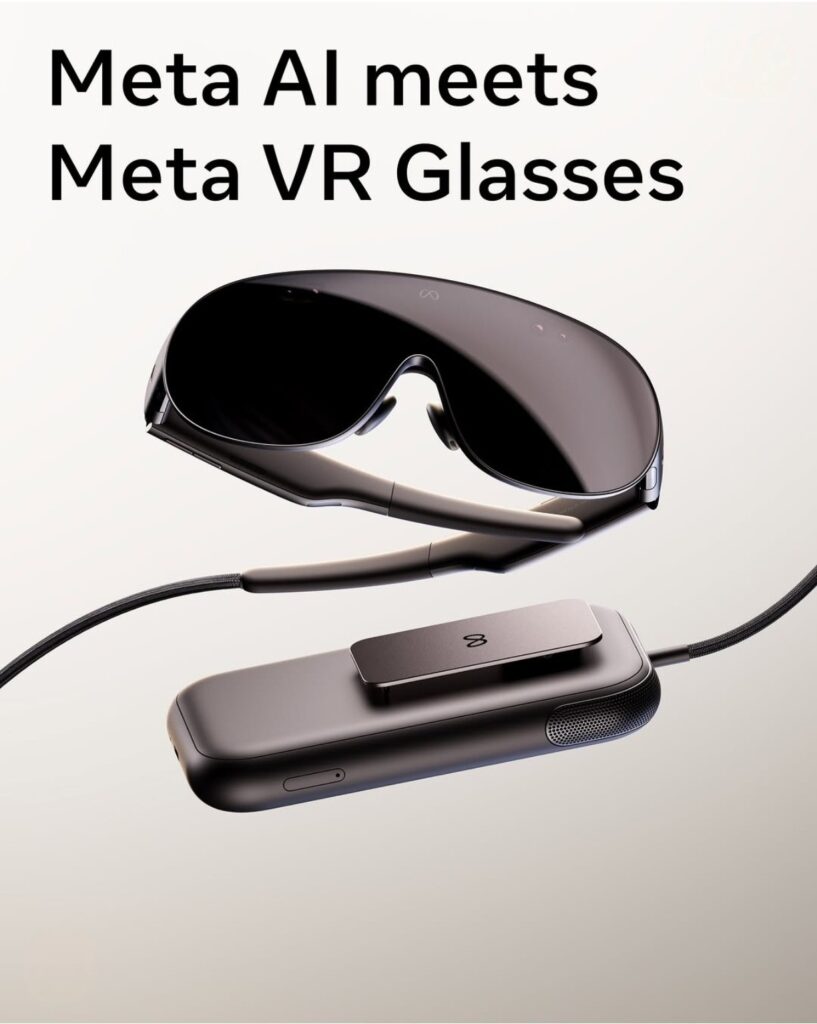
Meta VR Glasses are one of the biggest hardware announcements from Meta Connect 2026. They are not simply another pair of smart glasses: Meta is positioning them as a lightweight spatial-computing device that can act as a personal cinema, workspace, gaming system, and hands-free interface for Meta AI.
The product also connects directly to Meta’s broader AI strategy. Meta says its personal AI agent can be integrated into the glasses experience, letting people use voice, eye tracking, and natural hand gestures instead of relying on traditional controllers.
In this guide, we break down what Meta VR Glasses are, what Meta AI adds to the experience, the most practical use cases, the confirmed release date and price, and why this product matters for the next phase of personal AI.
What Are Meta VR Glasses?
Meta VR Glasses are a new virtual-reality device announced at Meta Connect 2026. According to Meta, the glasses weigh about 100 grams and split their hardware across two pieces: the glasses themselves and a connected computing puck that handles battery, storage, and processing.
That architecture is designed to make the headset dramatically lighter than a traditional VR device while still providing high-end spatial computing. Meta says the glasses use its Infinite Display 5K system and include color passthrough so you can still see your desk, phone, and surroundings while working or watching content.
Official source: Meta’s Meta VR Glasses announcement.
How Meta AI Fits Into the Experience
The most important part of Meta VR Glasses may be the AI layer rather than the display itself. Meta says its AI agent is integrated into the operating system, meaning users can speak naturally to the glasses and combine voice with eye and hand input.
That changes the interaction model. Instead of opening apps with a controller or navigating menus with a mouse, the user can ask the glasses to open something, search for information, adjust a workspace, or start media.
This is consistent with Meta’s larger move toward persistent personal AI. The company has also been developing Muse as a personal AI layer across devices and apps, making the glasses a natural place for that agent to become useful throughout the day.
What Can Meta VR Glasses Actually Do?
1. Control Media Hands-Free
One of the most obvious use cases is entertainment. Instead of touching a controller, users can ask the glasses to play, pause, skip, or search for content. Meta says the device is the first VR product certified for IMAX Enhanced experiences.
The company also says selected 3D movies will be available through streaming services, making the glasses a private cinema that can be used at home, while traveling, or in spaces where a television is not practical.
2. Ask Meta AI for Live Information
Because Meta AI is built into the system, the glasses can become a real-time information layer. The examples Meta has shown across its glasses products include checking sports scores, searching for nearby places, getting recommendations, and asking contextual questions.
This is where the glasses move beyond entertainment. Instead of pulling out a phone, the user can simply ask a question and continue what they are doing.
3. Manage Your Schedule and Daily Tasks
Meta has been emphasizing hands-free assistance across its AI glasses strategy. Calendar checks, reminders, planning, and other everyday tasks are especially relevant because they do not require a large visual interface.
If the agent becomes deeply connected to a user’s apps, the glasses could function as a wearable command center for daily planning rather than just a display.
4. Work in a Private Multi-Screen Workspace
Meta says the glasses can create a private multi-screen workspace and even turn a flat surface into a virtual keyboard and touchpad. That makes the product interesting for travel and remote work.
Instead of carrying multiple monitors, a user could open several virtual windows in front of them while still seeing the physical environment through passthrough.
5. Play Games Without Traditional Controllers
Meta says more than 75 games will support hand-gesture-only controls at launch, with hundreds of additional titles available through Xbox Cloud Gaming.
The combination of eye tracking, hand tracking, and AI-assisted interaction could make VR feel less like using a console and more like interacting directly with a digital environment.
6. Make Hologram Video Calls
Meta also announced a hologram-calling feature that creates a photorealistic digital version of the user, including real-time facial expressions and reactions. The company says the system can work with calling apps such as WhatsApp and Zoom.
This is one of the more experimental features, but it shows how Meta wants the glasses to blend communication, AI, and spatial computing.
Meta VR Glasses Release Date and Price
Meta says the VR Glasses will go on sale in spring 2027 for $1,299.99 in the United States.
That places them in a premium category, but they are also attempting to replace several devices at once: a VR headset, portable entertainment screen, multi-monitor workspace, and AI interface.
Why This Matters for the Future of AI
Most AI assistants today still live inside a browser tab or phone app. Meta VR Glasses point toward a different model: AI that is continuously available through a wearable device.
If the concept works, the important innovation may not be the glasses alone. It may be the combination of spatial computing, multimodal AI, and an agent that can understand commands and act across connected services.
That is the larger trend to watch. The competition is moving from “which chatbot gives the best answer?” toward “which AI can stay with you, understand context, and help you act in the real world?”
Final Take
Meta VR Glasses are one of Meta’s clearest attempts yet to merge AI, entertainment, productivity, and spatial computing into one wearable device. The product is expensive and will not ship until 2027, so many questions remain about comfort, battery life, app support, and real-world usefulness.
But the direction is clear: Meta wants AI to move off the phone and into devices that are always available. Meta VR Glasses are a major step toward that vision.