Updated September 27, 2026. This analysis is based on Meta’s September 8 Muse launch and the Meta Connect 2026 announcements.
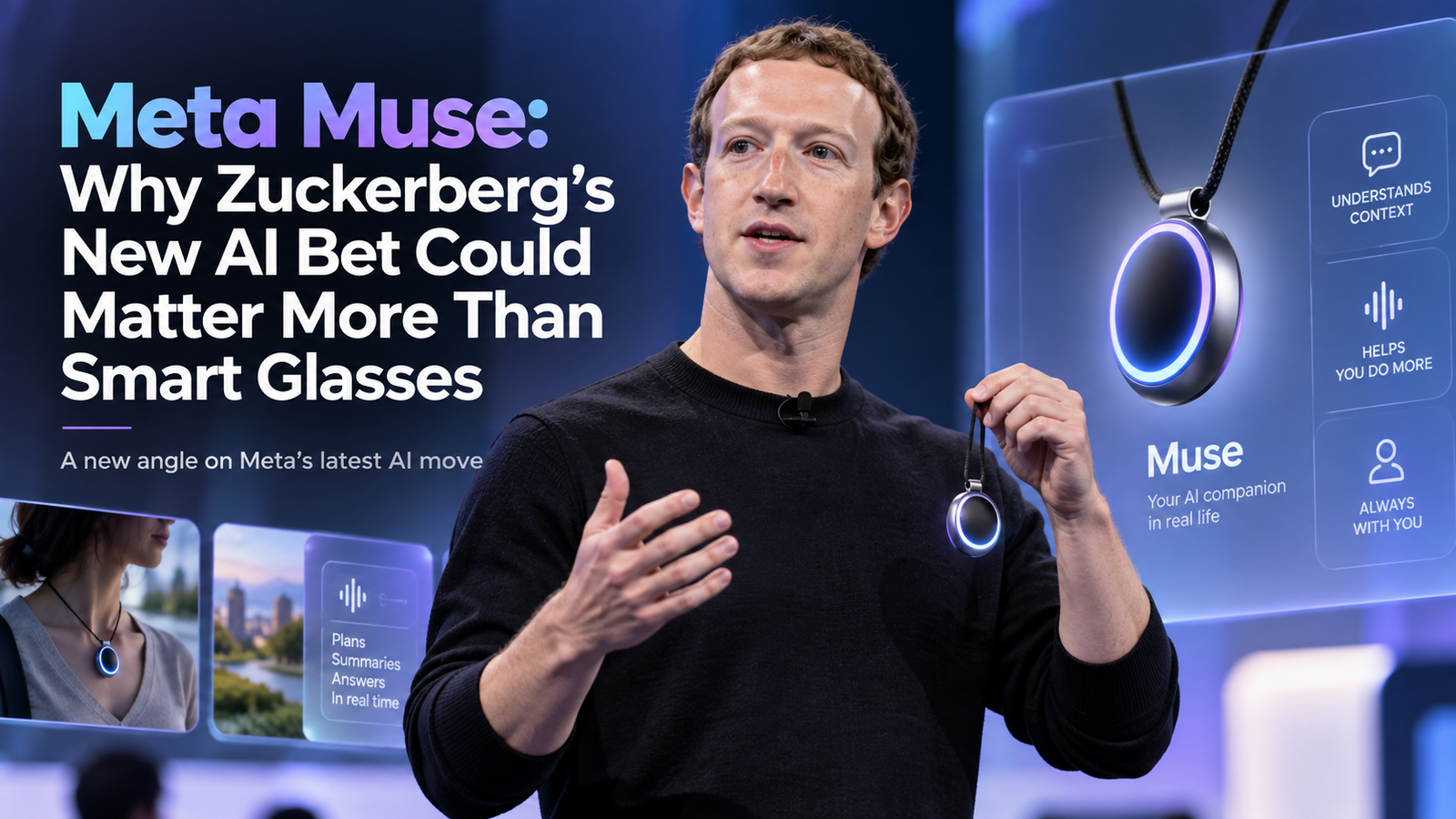
Meta’s new Muse Charm looks like a tiny gadget. The bigger story may be what sits behind it.
At Meta Connect 2026, Mark Zuckerberg presented Muse as more than another chatbot and more than an accessory for smart glasses. Muse is becoming an AI layer that can move between software, glasses and dedicated hardware — and that may be the more important strategic bet.
Meta first introduced Muse on September 8 as a personal AI agent that can take actions, remember context and work across services. Two weeks later, Zuckerberg showed how Meta wants to put that agent into the physical world: inside AI glasses and inside a small standalone device called Muse Charm.
That combination matters because Meta is no longer betting on one device. It is trying to make Muse the interface.
Muse is the product — the Charm is one doorway
Meta describes Muse as a personal AI agent rather than a conventional assistant. The company says it can handle tasks such as sending emails, booking travel and turning long-term goals into action plans. It can also remember information a user has shared and use that context later.
The technical centerpiece is Meta’s Muse Secure VM, a dedicated cloud computer that stores the agent’s data and connected-service credentials. Meta says a separate Sentinel agent reviews what Muse is allowed to do online and that users must confirm sensitive actions such as sending an email or making a purchase.
That architecture tells us something about Meta’s ambition: Muse is meant to do things, not just answer questions.
The Muse Charm is therefore easier to understand as an access point. Meta’s own Connect announcement describes it as a small device designed to let people talk to and interact with Muse. The company also said Muse is being integrated into its AI glasses.
Why this could matter more than another generation of smart glasses
Smart glasses are important to Meta, but they still require people to accept a specific form factor: something worn on the face.
Muse can potentially escape that limitation.
A user might reach the same agent through WhatsApp, a phone app, glasses or a small dedicated device. The hardware can change while the agent — its memory, context and permissions — remains the same.
That is a fundamentally different platform strategy.
Instead of asking, “Will everyone wear Meta glasses?”, the question becomes, “Will people let Muse become the AI that handles their everyday tasks?”
That is a much larger market if Meta can earn enough trust.
The real post-smartphone bet is continuity
The smartphone became powerful partly because it became the place where identity, communication, payments, navigation and apps came together.
AI agents could change that model.
If an agent understands what you are doing, remembers your preferences and can take actions across services, the interface may matter less than the continuity of the agent itself.
That is where Muse becomes strategically interesting.
You could start a request in WhatsApp, continue through glasses while walking, and later use a Charm-like device without starting from zero each time. Meta has not promised every one of those exact cross-device workflows, but its announced direction points toward Muse being available across multiple surfaces.
This is why the Charm should not be judged only as a piece of hardware. Its importance may be that it gives Meta another route to put Muse between the user and the smartphone.
Zuckerberg is also trying to reduce Meta’s dependence on other platforms
There is another strategic layer.
Meta has spent years building major businesses on top of operating systems controlled by Apple and Google. A successful AI agent plus first-party hardware could give Meta more control over how users access services.
Reuters described Muse Charm as part of a broader effort by Meta to move beyond dependence on Apple and Google’s platforms.
This does not mean smartphones disappear. It means Meta wants a layer that can sit above apps and, in some situations, make the phone less central.
Muse still has to solve the hardest problem: trust
The strategy is ambitious, but the risks are equally large.
An agent that can read messages, remember personal context, book services or make purchases needs access to sensitive information. Meta says users control which services Muse can connect to, that credentials are stored separately, and that Muse asks for approval before sensitive actions.
Those safeguards will matter because adoption depends on more than intelligence. People have to trust the agent enough to give it permission to act.
That is especially relevant after the privacy controversy surrounding AI wearables and smart glasses. We covered that issue separately in our analysis of the Meta smart-glasses privacy backlash.
The Charm could succeed even if it never becomes a mass-market gadget
This is the counterintuitive part.
Muse Charm does not necessarily need to become the next iPhone for the product to matter.
If it helps Meta normalize the idea that a personal AI agent should be always available, persistent and able to take action, the device could still serve its purpose.
The same agent can later appear in glasses, earbuds, phones, watches, cars or devices Meta has not announced yet.
In that sense, the Charm may be a prototype for a behavior rather than merely a product category.
What to watch next
- Pricing: Meta has not yet provided full consumer pricing for Muse Charm.
- Availability: Meta says more details are coming later in 2026; recent reporting says a December launch is targeted.
- International rollout: Muse currently has limited geographic availability, with expansion planned.
- Third-party integrations: the value of an agent depends heavily on which services allow it to take actions.
- Privacy controls: watch whether Meta expands the security and consent model as Muse gains access to more personal data.
- Hardware adoption: the key signal will be whether people use Muse across multiple devices rather than only inside one app.
Bottom line
The eye-catching part of Meta Connect was Zuckerberg holding up a tiny new AI gadget. The more consequential announcement may be the idea behind it.
Meta is building Muse as an agent that can follow the user across software and hardware. If that works, the company does not need one device to replace the smartphone. It needs Muse to become the layer people turn to before they open an app.
That is a much bigger bet than a keychain-sized Charm — and potentially a more important one than any single generation of smart glasses.
Leave a Reply