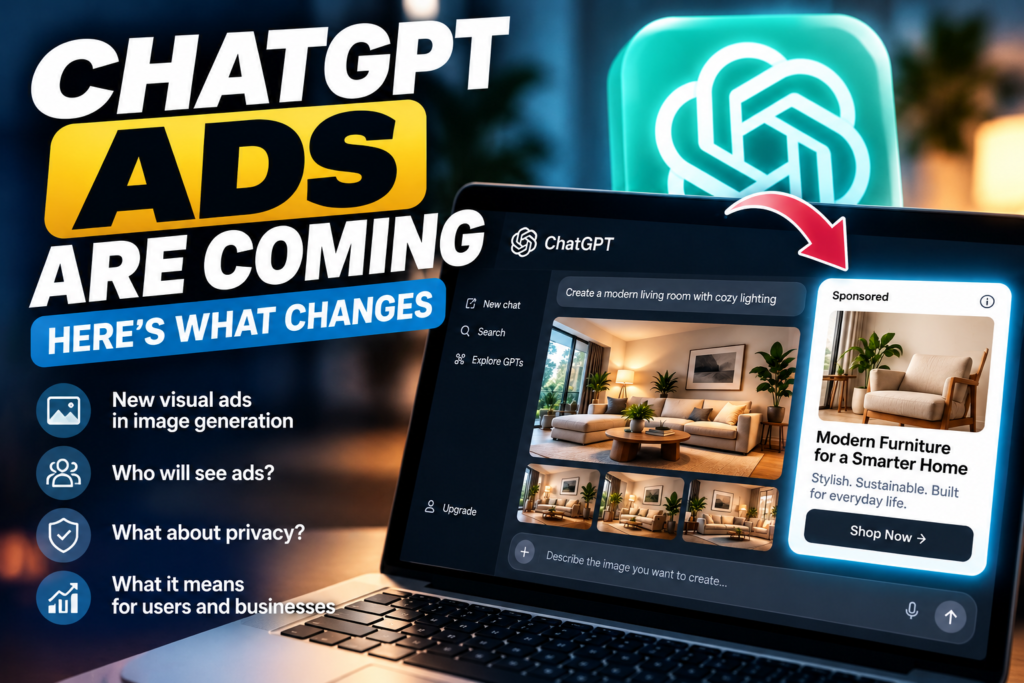
ChatGPT ads are entering a more visual phase. On October 5, 2026, OpenAI announced a new advertising format that will be tested during image generation in ChatGPT, placing clearly labeled sponsored visuals alongside the images users create.
The timing matters. OpenAI says ChatGPT now reaches about 1.2 billion people each week, giving advertisers access to a huge audience at the exact moment users are exploring products, comparing options, and making decisions. The new format is scheduled to begin testing later in October in the United States with an initial group of advertisers.
What Are the New ChatGPT Ads?
The new ChatGPT ads are visual sponsored placements designed to appear during the image-generation experience. OpenAI says the ads will remain separate from the image being created and will be clearly labeled, so users can distinguish sponsored content from ChatGPT’s output.
In practice, this could make advertising inside an AI assistant feel very different from a traditional search ad. Someone generating ideas for a living room, travel plan, outfit, or product concept may see a relevant visual ad near the generated result. OpenAI describes the format as a way to help people discover products and services and imagine how they could fit into their lives.
OpenAI’s official announcement is available on its ChatGPT Ads update.
When Will ChatGPT Visual Ads Launch?
OpenAI says testing of the new visual format will begin later in October 2026 in the United States. The first phase will involve an initial group of advertisers, so not every user will see the new ad format immediately.
This is an expansion of an advertising program that OpenAI began testing earlier in 2026. The company has since added new buying, measurement, and attribution tools for advertisers, suggesting that ChatGPT advertising is becoming a serious long-term business channel rather than a small experiment.
Who Will See ChatGPT Ads?
According to OpenAI’s current advertising FAQ, ads may appear for eligible users on the Free and Go plans. ChatGPT Plus, Pro, Business, Enterprise, and Edu accounts remain ad-free. OpenAI also says it does not show ads to accounts identified as belonging to users under 18.
The company also offers an ads-free option on the Free plan in supported regions, but that option comes with reduced usage limits and less access to certain features. Users who want the full paid experience without ads can use an eligible premium plan.
Do ChatGPT Ads Influence AI Answers?
OpenAI says they do not. Advertising is handled separately from the systems that generate ChatGPT’s answers, and advertisers cannot pay to change, rank, or shape a response. Sponsored placements are designed to be visually separated and clearly labeled.
This separation is critical. ChatGPT is increasingly used for product research, software comparisons, travel planning, and purchasing decisions. If users could not tell the difference between an independent answer and a paid placement, trust in the assistant would fall quickly.
What About ChatGPT Ads and Privacy?
Privacy is one of the biggest questions surrounding AI advertising. OpenAI says conversations are kept private from advertisers and that user data is not sold to advertisers. Advertisers receive aggregated performance information such as views and clicks rather than private chat histories or personal conversation details.
However, ad selection can use the context and intent of the current conversation to determine relevance. When ad personalization is enabled, additional signals from a user’s broader ChatGPT experience may also contribute. Users can control personalization in ChatGPT’s ad settings and can hide or report individual ads.
OpenAI provides more detail in its Ads in ChatGPT FAQ.
Why ChatGPT Ads Could Matter More Than Normal Display Ads
The biggest opportunity is not simply ChatGPT’s audience size. It is the amount of intent users express in a conversation. A normal search might contain a few words such as “best laptop for travel.” In ChatGPT, a user may explain budget, use case, preferred weight, battery needs, software requirements, and the exact problem they want to solve.
That richer context could allow ads to appear at a highly relevant point in the decision process. For marketers, this shifts the focus from simple keyword targeting toward understanding user goals, constraints, and conversational intent.
Could ChatGPT Ads Become a Google Ads Competitor?
Google built a massive advertising business around search intent. ChatGPT now sits inside many of the same decision-making journeys: users compare products, evaluate software, research destinations, explore purchases, and ask for recommendations.
That does not mean ChatGPT will replace Google Ads. Search remains enormously powerful, and ChatGPT’s ad platform is still young. But the combination of conversational context, visual generation, and more than a billion weekly users creates a new type of advertising environment that marketers cannot ignore.
This development also fits into the broader competition among major AI platforms. We recently compared OpenAI, Google, and Meta in the AI agent race, where distribution and ecosystem reach are becoming just as important as model quality.
What ChatGPT Ads Mean for Businesses
For ecommerce brands, SaaS companies, creators, and small businesses, ChatGPT ads could eventually become another acquisition channel alongside Google, Meta, TikTok, and other platforms. The major difference is that ads can appear while users are actively trying to solve a problem or make a decision.
Businesses should therefore begin thinking beyond traditional keywords. The important question becomes: What does a potential customer ask an AI assistant before choosing a product like ours? Brands that understand those conversations may be better positioned as AI advertising expands.
For a broader look at using AI practically inside a company, see our AI tools for small business workflow guide.
The Bigger Picture
The arrival of visual ChatGPT ads is bigger than a new ad unit. Search engines monetized keywords. Social platforms monetized interests and feeds. AI assistants may increasingly monetize intent expressed through conversations.
If OpenAI can preserve the boundary between useful answers and paid placements, ChatGPT could become a powerful new advertising platform. If that boundary becomes unclear, users may push back. The next few months will show how OpenAI balances monetization, relevance, privacy, and trust.
Frequently Asked Questions About ChatGPT Ads
Does ChatGPT have ads?
Yes. OpenAI has been testing ads in ChatGPT during 2026, and eligible Free and Go users may see sponsored placements in supported regions.
What are ChatGPT visual ads?
They are sponsored visual placements that OpenAI plans to test during image generation. They are designed to appear separately from the image created by ChatGPT.
When do the new ChatGPT image-generation ads launch?
OpenAI says testing will begin later in October 2026 in the United States with an initial group of advertisers.
Which ChatGPT plans show ads?
Ads may appear on eligible Free and Go accounts. Plus, Pro, Business, Enterprise, and Edu accounts remain ad-free according to OpenAI’s current FAQ.
Do ChatGPT ads change the answers I receive?
No. OpenAI says ads run on separate systems and advertisers cannot pay to influence ChatGPT’s responses.
Can advertisers read my ChatGPT conversations?
No. OpenAI says advertisers do not receive users’ private conversations, chat history, memories, or personal details. Advertisers receive aggregated ad performance information instead.
Can I turn off personalized ChatGPT ads?
Yes. Users in eligible regions can manage ad personalization in ChatGPT’s ad controls. Turning personalization off changes how ads are selected, while an eligible ads-free plan or option removes ads entirely.