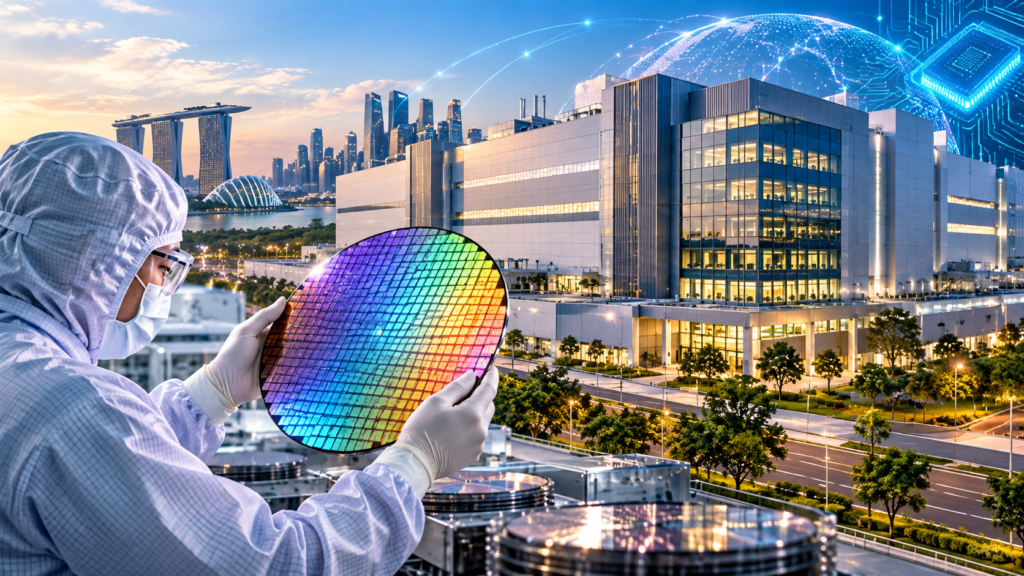
Singapore has opened a new S$8.5 billion (about US$6.7 billion) semiconductor fab in Tampines, and the headline numbers are big: up to 44,000 300mm wafers per month at full capacity, around 1,600 jobs, and volume production scheduled to begin in the first quarter of 2027.
But the most interesting part for the AI industry is not that this factory will suddenly produce the world’s most advanced AI GPUs. It won’t. The new VisionPower Semiconductor Manufacturing Company (VSMC) facility is focused on 40nm to 130nm specialty processes for mixed-signal, power management, analog and interposer applications.
That still matters for AI. Modern AI systems depend on far more than cutting-edge accelerators. They also need power-management chips, sensors, connectivity components, automotive electronics, industrial controllers and packaging infrastructure. Singapore’s new fab is a reminder that the AI boom is also an infrastructure boom.
What exactly opened in Singapore?
VSMC is a joint venture between Vanguard International Semiconductor Corporation and NXP Semiconductors. The company completed construction of its first 300mm wafer fab in Tampines after roughly 22 months of work and has entered the risk-production stage. According to NXP, volume production is expected to start in Q1 2027, with capacity rising toward approximately 44,000 12-inch wafers per month by 2029.
The fab is designed for specialty semiconductor technologies from 130nm down to 40nm. Those chips are intended for applications including high-performance computing, mobile devices, automotive systems, industrial equipment and consumer electronics.
That distinction matters. The factory is not positioned as a direct competitor to the leading-edge fabs that manufacture the most advanced AI accelerators. Instead, it targets the broad set of chips that keep modern devices, factories and connected systems working.
Why specialty chips matter for AI
When people hear “AI chips,” they usually think of GPUs and other high-end accelerators. But an AI-enabled system is a stack of many different components.
- Power-management ICs regulate power across devices and computing systems.
- Analog and mixed-signal chips connect digital computing to real-world signals from sensors, cameras and industrial equipment.
- Automotive chips support increasingly software-defined and AI-assisted vehicles.
- Interposer technologies can play a role in advanced semiconductor packaging and high-performance computing systems.
- Industrial semiconductors support automation, robotics, predictive maintenance and connected manufacturing.
In other words, the AI economy needs both frontier processors and a huge supply of less glamorous—but essential—specialty silicon.
The factory itself is using AI
There is another AI angle: VSMC says the fab will operate with a highly automated smart-manufacturing model and use artificial intelligence and digital-management technologies to improve efficiency and quality.
This is a useful example of how AI is moving from software products into physical industry. Semiconductor manufacturing is extremely complex, and even small improvements in yield, process control, maintenance or defect detection can have major economic value.
The shift also mirrors a broader trend we cover on Practical AI Tools: AI is increasingly becoming an operational layer inside real businesses, not just a chatbot interface. You can see the same movement in our coverage of Meta’s broader AI platform strategy and in the growing role of AI-powered hardware such as next-generation smart glasses.
1,600 jobs—and most are technical roles
The Singapore government says the project is expected to create about 1,600 jobs. Around 75% are expected to be professional, managerial, executive and technician roles, including positions for engineers, chemists and data scientists.
That is significant because semiconductor expansion is not only a capital-investment story. It also creates demand for advanced manufacturing skills, process engineering, automation, data analysis and equipment expertise.
Singapore already has a semiconductor workforce of more than 35,000 people, and the country has been investing heavily in training, research and industry partnerships.
Why Singapore keeps attracting chip investment
Singapore has become a major node in the global semiconductor supply chain. The Singapore Economic Development Board says the country accounts for roughly one in 10 chips produced worldwide and about one-fifth of global semiconductor equipment production.
From 2022 to 2025, Singapore attracted more than S$30 billion in semiconductor investments. Its appeal comes from a combination of infrastructure, skilled talent, logistics, intellectual-property protection and a large ecosystem of equipment and materials suppliers.
The VSMC fab is part of a much larger wave. Singapore has also attracted major investments from Micron, UMC, GlobalFoundries and other semiconductor companies.
The bigger AI infrastructure story
The most important takeaway is that the AI race is becoming increasingly physical.
Training models and running AI applications require data centers, networking, power systems, memory, sensors, packaging, cooling and huge volumes of semiconductors. The most advanced processors get most of the attention, but the surrounding ecosystem is equally important.
That means a factory producing 40nm to 130nm specialty chips can still benefit from the same macro trends driving AI, electric vehicles, robotics, industrial automation and connected devices.
Singapore’s Economic Development Board expects the global semiconductor market to reach about US$1.6 trillion by 2030, with AI and electrification among the major growth drivers.
What this does—and does not—mean for Nvidia-style AI chips
It is important not to overstate the connection.
VSMC is not opening a cutting-edge 2nm or 3nm fab designed to manufacture the latest AI GPUs. Its specialty-node strategy serves different products and markets. But AI hardware does not operate in isolation: advanced computing systems still depend on many supporting chips and technologies.
So the right conclusion is not “Singapore just opened a new AI-chip factory.” A more accurate conclusion is that Singapore is strengthening the broader semiconductor infrastructure that supports the AI era.
What to watch next
Three milestones will be worth following. First, whether VSMC begins volume production on schedule in Q1 2027. Second, how quickly it ramps toward its planned 44,000-wafers-per-month capacity by 2029. Third, whether Singapore continues to attract additional investment in advanced packaging, memory and AI-related semiconductor technologies.
For anyone tracking the business of AI, this is the key lesson: the next phase of artificial intelligence will be shaped not only by better models, but also by the factories, energy systems, chips and supply chains that make those models possible.